

Humans & Bots.
Growing together.
인간과 봇이 협력하는 AX경영 · by Won-Woo Park
Explore Professor Park’s book on human–bot collaboration: augmenting people and bots, designing complementary roles, and building accountable organizations.
About the Book
As AI technology advances rapidly, two extreme narratives have emerged. One worships technology, claiming that “AI will solve everything”; the other expresses the existential fear that “humans will eventually be replaced.”
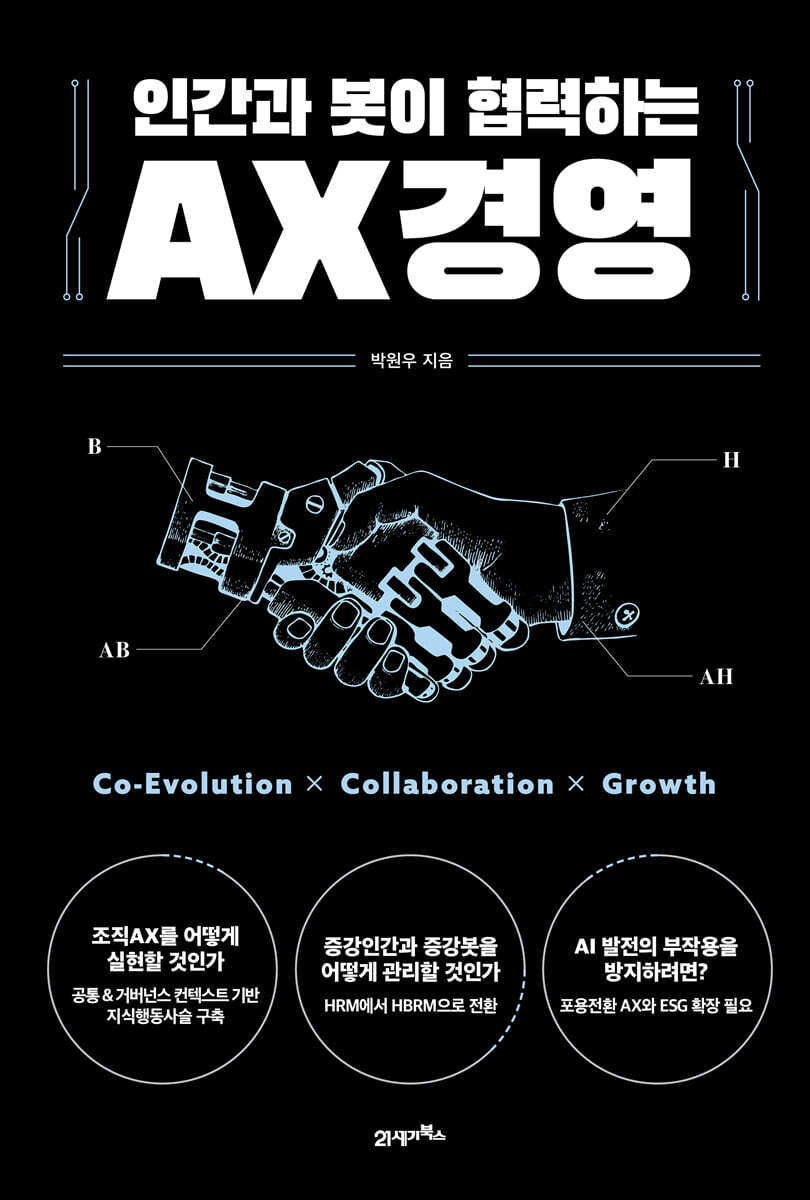
This book takes neither position. Instead, it centers on augmentation. Augmentation is not limited to people: humans are augmented (H→AH), and so are bots (B→AB). This idea of two-way augmentation distinguishes the book from other AI titles. Rather than asking who is superior—humans or AI—it asks how their respective strengths can be connected.
The book identifies four kinds of organizational members: humans (H), augmented humans (AH), bots (B), and augmented bots (AB). Their combinations yield four forms of collaboration: H+B, H+AH, AH+B, and AH+AB. Only the AH + AB organization, where both humans and bots are augmented and coexist and collaborate as equals, is a true AX organization. “Co-Evolution × Collaboration × Growth” encapsulates this aspiration.
The book advances the innovative concept of HBRM (Human Bot Resource Management). When organizations consist of H, AH, B, and AB rather than only humans, management itself must change. Bots perform work, collaborate with people, and affect organizational performance and risk; they therefore need to be managed within structures of roles, authority, verification, and accountability. In this context, the author argues that bot ethics must be designed rather than taught. He proposes a five-stage architecture: embed respect for humans in reward functions; define absolute prohibitions as binding rules; use RLHF and RLAIF to learn subtle social contexts; establish pre- and post-verification layers; and prevent collusion in multi-agent environments.
Source: Kyobo Book product page. English is a website translation, not an official publisher translation. View source ↗
Table of Contents
Preface
Part 1. The arrival of an unfamiliar colleague: the bot
Chapter 1. AX organizations where humans and bots coexist and collaborate
Chapter 2. Management for the growth and happiness of both humans and bots
Part 2. Augmenting humans (H → AH) and bots (B → AB)
Chapter 3. Competencies, roles, and leadership of talent in AX organizations
Chapter 4. Bot socialization, education, and HBRM
Part 3. Improving teamwork and performance in hybrid organizations
Chapter 5. Team role balance (TRB): a leading approach to managing diversity and pursuing complementary fit
Chapter 6. TRB in organizations where humans and bots coexist
Part 4. Accelerating organizational AX and addressing AI-based stratification
Chapter 7. Operating foundations of AX: common context, governance context, and knowledge chains
Chapter 8. Inclusive-transition AX and the expansion of ESG
Source: Kyobo Book product page. English is a website translation, not an official publisher translation. View source ↗
Inside the Book
Traditional human-centered organizations are of the H + H type, whereas organizations in which humans and bots coexist combine H, AH, AB, and B in various ways. Organizations consisting solely of bots, without humans (B + B, B + AB, AB + AB), are excluded from consideration because they are not what we seek. (…) The most desirable form of human–bot coexistence is AH + AB. This is the human–bot coexistence and collaboration organization that advances human development: a true AX organization. Here, AB is not merely a tool but an already augmented entity that makes judgments jointly with humans. Realizing organizational AX is a race to reach this AH + AB type—a hybrid organization—first.
What matters in an AX organization is not an increase in people who know how to use AI tools. What matters is that members can define problems, construct context, direct execution, verify results, judge responsibility, record evidence, and incorporate improvements so that they can work with AI. Talent in an AX organization is therefore not someone who simply assigns work to AI. It is someone who provides work standards, judgment structures, accountability criteria, and evidence systems so that AI operates safely and verifiably within the organization’s formal work. More concisely, such a person designs and manages AI operating standards rather than merely using AI.
If a manager asks, “What is your role?”, people usually describe a functional role: “I handle recruitment” or “I handle payroll.” They do not say, “I am the person who makes things enjoyable” or “I am the critic.” Yet these team roles must exist for teamwork to emerge. An individual may perform a given functional role well while failing to perform any team role properly. Conversely, one person may perform several team roles well at the same time.
Humans interpret meaning, make ethical judgments, build relationships, and fulfill responsibilities; bots complement and augment these activities. The core of TRB in an AX organization is designing a role structure that optimally connects human and bot strengths. Traditional human-centered organizations clearly had differences in individual ability. In AX organizations, however, the individual capabilities of AI bots are leveled. Role combinations, orchestration, coordination, and governance therefore become much more important. Competitiveness ultimately depends less on who uses AI than on who designs role structures better. This is why TRB matters more in AX organizations.
Efficiency-centered AX creates an organization that is more efficient through AI. Inclusive-transition AX creates an organization that is more efficient through AI while protecting human capabilities and rights. It does not reject efficiency-centered AX. But because efficiency alone is insufficient, inclusive-transition AX redesigns organizational transformation around accountability and inclusion, ensuring that AI transformation does not undermine people’s roles or their rights to judgment, learning, transition, objection, and sharing in the gains.
Source: Kyobo Book product page. English is a website translation, not an official publisher translation. View source ↗
Author · Won-Woo Park
After earning a bachelor’s degree (1982) and a master’s degree (1984) from SNU Business School, Park received a U.S. government Fulbright scholarship and earned a doctorate in human resources and organizational behavior from the University of Pittsburgh’s business school (1989). After serving as an assistant professor at Pittsburgh, he returned to Korea and taught at Chung-Ang University and Kyung Hee University. He was a professor at SNU Business School from 1998 to 2024 and is now Professor Emeritus.
His research interests include groupthink, teamwork, empowerment, trust, efficacy, goal orientation, transformation, culture change, and happiness management. He has published approximately 140 academic papers in Korea and abroad and 16 books, and has received SNU Business School’s teaching excellence award several times. He also received Seoul National University’s Academic Research and Education Award in 2018 and an Emerald Publishing Literati Award in 2020.
Since 2022, he has been running GESIA Platform, a startup developing advanced blockchain and AI technologies, and GEC (Green Earth Community), a nonprofit association that aims to create a habitable environment for humanity by achieving net zero.
Source: Kyobo Book product page. English is a website translation, not an official publisher translation. View source ↗
Publisher’s Review
The central question is how to design the roles of humans and AI, rather than how much AI is used.
Organizational AX is a matter of corporate survival, beyond competitiveness.
How to build strong organizations through the co-evolution of augmented humans and augmented AI.
Diagnosing organizational AX today and charting its future: start with measurement!
The book diagnoses current organizational AX problems and proposes solutions. Its strength lies in offering measurement indicators alongside guiding concepts: AI utilization (AIU), Augmentation Quotient (AQ), Augmented Human Index (AHI), Augmented Human Competency Index (AHCI), Augmented Role Balance Index (ARBI), and AX operating indicators DCI, KCDI, AHCI, ARBI, and RCI.
Adding inclusive transition to an efficiency-dominated AX discourse
Efficiency, productivity, cost reduction, and automation dominate global AX. The author sees these as necessary but insufficient. When AI enters organizational judgment, generation, execution, evaluation, and recordkeeping, the questions become who can use AI, who sets its standards, who is evaluated by AI, and who benefits from AI productivity. The book introduces Context Capital, arguing that productive resources in the AI era extend beyond models, data, and compute to purposes, standards, language, materials, authority, and verification systems. The solution is to turn this context capital into a shared productive foundation for the entire organization rather than leaving it in the hands of a few. This is inclusive-transition AX.
Advancing ESG
The book proposes expanding ESG, which already enjoys broad acceptance in international and corporate communities, as a practical route to inclusive-transition AX. E extends to environmental responsibility for AI infrastructure, data centers, and compute. S extends to AI access, learning rights, role transitions, human judgment rights, and equal opportunities to develop AI capabilities. G extends to authority, verification, approvals, records, explanation, objections, accountability, and improvement loops. Just as climate transitions should not abandon workers and communities, AI transitions must not abandon human roles, income, judgment, learning, or dignity. This is the logic of Just AI Transition ESG. Extending existing principles of responsibility to AI-era risks can make implementation more feasible amid today’s proliferation of concepts.
Preventing the loss of spirit and soul (魂飛魄散): a reflection on humanity, beyond a technology book
This is a distinctive and groundbreaking theme. Drawing on the traditional concepts of spirit (靈), soul (魂), and corporeal vitality (魄), the author argues that when AI externalizes human cognition and judgment and robots externalize physical work, what humans must preserve is their spirit rather than computational ability. He emphasizes independent judgment, responsibility for one’s actions, sensitivity to others’ suffering, respect for life and dignity, the ability to ask about meaning before efficiency, and the agency to refuse a system’s commands. AI can extend the human soul; robots can extend human physical capacities; but spirit cannot be outsourced. This is not a prediction of a distant disaster, but a warning that asks how people can preserve these dimensions of humanity in the face of technology today.
World models and predictive intelligence
From the perspective that AI’s fundamental change lies in prediction rather than generation, the book proposes a five-layer predictive intelligence stack: the real world → data → knowledge chains → models → prediction and simulation. An error in answer-generating AI may end with an incorrect sentence; an error in world-model-based AI can lead to flawed decisions and resource allocation. AI governance therefore grows more important as world models advance.
☞ Related titles from 21st Century Books
▶ AI는 인간을 어디로 이끄는가 | SNU Institute for Future Strategy | 21st Century Books | August 27, 2022 | KRW 25,000
▶ 모두 인공지능 백신 맞았는데 아무도 똑똑해지지 않았다 | Yoo Young-man | 21st Century Books | March 28, 2026 | KRW 19,800
▶ 넥스트 AI, 공간 컴퓨팅 | Choi Hyung-wook and Jeon Jin-soo | 21st Century Books | February 26, 2026 | KRW 22,000
☞ Publisher channels for book information, videos, and events
▶ Facebook facebook.com/jiinpill21 ▶ Naver Post post.naver.com/21c_editors ▶ Instagram instagram.com/jiinpill21
▶ Website www.book21.com ▶ YouTube youtube.com/book21pub
Source: Kyobo Book product page. English is a website translation, not an official publisher translation. View source ↗
GESIA connects knowledge and action.
GESIA develops intelligence infrastructure that structures individual and organizational knowledge, experience and judgment for AI use.
Common Context connects goals and knowledge. Governance Context defines authority, approvals and verification. The Knowledge–Action Chain links working knowledge to execution, verification and learning.
Explore our technology and BOT APPLICATION service to consider how human–bot collaboration can take shape in practical work.
Book and author information: YES24 ↗ · The GESIA overview is based on this website’s technology description.
Bring collaboration into everyday work.
Explore bot services and samples, then discuss an approach suited to your organization’s goals and work.